Leonardo Sciascia
- Home
- Sicilian Culture
- Sicilian Food
- Sicilian Wines
- White Wines
The White Wines of Sicily: A Guide to Sicily's Best Varietals
The white wines of Sicily emerge from the crucible of heat and history, transformed from rustic obscurity into vessels of crystalline precision and aromatic complexity.
What was once dismissed as mere table wine now commands the attention of sommeliers and collectors across continents, a resurrection born of dedication and terroir.
The island spans 25,711 square kilometers of Mediterranean terrain, with its vineyards rising from sea level to heights exceeding 900 meters, each elevation imparting its signature to the liquid within the bottle.
Consider how geography becomes destiny in these wines, how the meeting of African heat and European technique forges something entirely singular.
A Short History of Modern Sicilian Wines
The transformation of white wines of Sicily - as well as other local wines - began in earnest during the late twentieth century, when a generation of vintners returned to indigenous varieties with renewed reverence and modern methodology.
They abandoned the bulk-wine mentality that had defined Sicilian viticulture for decades, instead pursuing quality through reduced yields and meticulous cellar practices.
Today, the best white wines of Sicily rival their counterparts from Burgundy, Alsace, and the Mosel in complexity and age-worthiness.
However, they speak in a distinctly Mediterranean dialect. The volcanic soils of Mount Etna, the calcareous clays of Trapani, and the sandy loams of Vittoria each contribute their mineral vocabulary to wines that shimmer with both power and restraint.
It has not been a sudden rupture but a gradual awakening, a slow recognition.
White Grapes of Sicily
Let's begin our overview of white wines of Sicily by taking a look at the different grape varieties. Most of them have been grown on the island for hundreds of years, but there are also some international varieties. These are sometimes used to complement Sicilian grapes.

Grillo
Grillo stands as Sicily's most widely planted white variety.
This grape thrives in the island's western reaches, where the Phoenicians first planted vines three thousand years ago.
Its thick skin resists the dry sirocco winds that blow from North Africa. At the same time, its naturally high acidity preserves freshness despite the relentless sun.
In the hands of skilled winemakers, Grillo yields wines of remarkable texture and aromatic breadth—notes of white peach, almond blossom, and Mediterranean herbs layered over a saline minerality that speaks of proximity to the sea.
The variety once served primarily as a base for Marsala production, its potential for fine table wine overlooked until recent decades.
Now it anchors some of the most compelling white wines of Sicily, bottlings that pair equally well with raw seafood and aged cheeses, their versatility a testament to balanced structure.
Carricante
Carricante reigns supreme on the eastern slopes of Mount Etna, where it has adapted over centuries to volcanic ash and dramatic daily temperature shifts.
This variety produces wines of piercing acidity and mineral intensity, their profiles more reminiscent of Chablis than of typical Mediterranean whites.
The vines grow at altitudes between 400 and 1,000 meters, their roots penetrating deep into porous volcanic substrata in search of water and nutrients.
Carricante wines often require years in the bottle to reveal their whole complexity, developing notes of citrus peel, flint, smoke, and wild mountain herbs as they mature.
The best examples can age for two decades or more, their acidity acting as both preservative and structural spine.

Catarratto
Catarratto exists in two distinct biotypes—Catarratto Comune and Catarratto Lucido—each contributing different characteristics to Sicily's white wine tapestry.
This variety covers vast expanses of the island's interior and western provinces, its productivity once valued over its quality. Modern viticulturists have tamed its vigor through careful site selection and yield management, coaxing forth wines of surprising elegance and aromatic intensity.
The grape expresses itself differently across microclimates: in cooler zones, it offers green apple and citrus notes; in warmer areas, tropical fruit and almond notes.
Catarratto often appears in blends, lending body and aromatic lift to wines anchored by other varieties. However, single-varietal bottlings have gained prominence among quality-focused producers.
Its adaptability makes it indispensable to Sicily's white wine production, a chameleon that reflects its environment with remarkable fidelity.
International Varieties
International varieties—Chardonnay, Sauvignon Blanc, Viognier—have found homes in Sicily's diverse microclimates. However, they remain secondary to indigenous grapes in both acreage and prestige.
Some producers craft compelling expressions of these varieties, with their Sicilian terroir imparting a distinctive character that sets them apart from their Old World archetypes.
Chardonnay from high-altitude sites achieves remarkable freshness and mineral tension. At the same time, Sauvignon Blanc develops tropical notes alongside its characteristic herbaceousness.
Yet the trend among quality-conscious vintners increasingly favors native varieties, recognizing that Sicily's uniqueness lies in grapes found nowhere else.
Wine Regions of Sicily
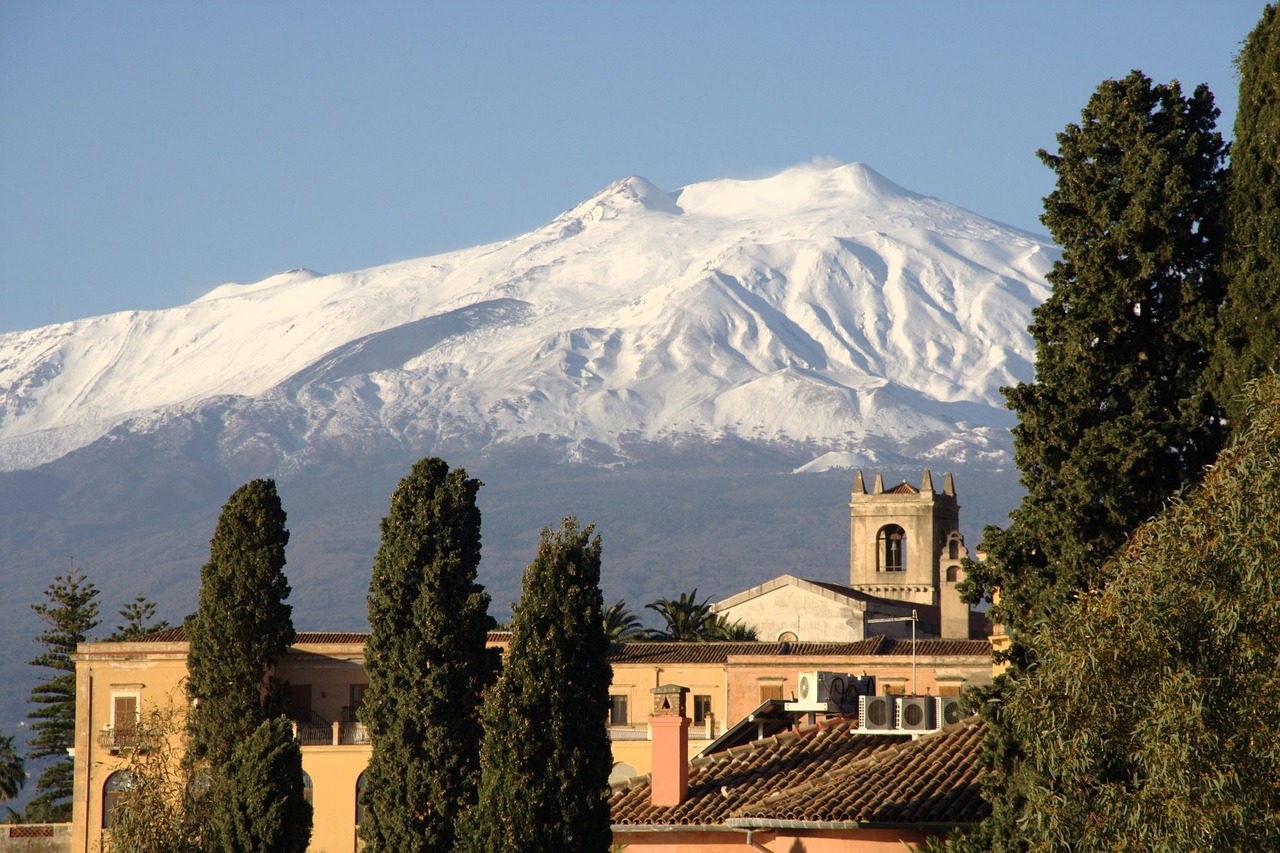 Etna produces some of the best wines in Sicily.
Etna DOC
The Etna DOC designation encompasses vineyards clinging to the slopes of Europe's most active volcano, where viticulture becomes an act of faith and defiance.
Here, the white wines achieve a tension between ripeness and acidity that defines their character, the cool mountain air tempering the Sicilian sun's intensity.
Carricante dominates the white plantings, often blended with small percentages of other indigenous varieties, such as Catarratto, Minella, and Grecanico.
The volcanic soils—a complex mixture of ash, pumice, and basalt—impart a distinctive smoky minerality that marks these wines as unmistakably Etnean.
Vineyards are often terraced with dry-stone walls, and the ancient alberello training system is still employed on the oldest sites; each vine is a gnarled testament to endurance.
Contrada wines represent the pinnacle of Etna's white wine production, single-vineyard expressions that capture the essence of specific volcanic terroirs.
These designations—Contrada Santo Spirito, Contrada Calderara, Contrada Guardiola, and others—function as Sicily's answer to Burgundy's climats, delineating parcels with distinct geological and climatic identities.
The wines command premium prices and critical acclaim, their production limited by the small size of individual contrade and the labor-intensive nature of mountain viticulture.
These are wines for contemplation and cellaring, their complexity unfolding over hours in the glass and years in the bottle.
Trapani Region
The western province of Trapani produces white wines of a different temperament, shaped by maritime influence and limestone-rich soils.
Grillo thrives here, alongside Catarratto and the increasingly rare Zibibbo (Muscat of Alexandria), which produces both dry and sweet expressions.
The Alcamo DOC and Erice DOC designations encompass much of this production. However, many top wines carry the broader Sicilia DOC or IGT classifications.
These wines tend toward fuller body and riper fruit profiles than their Etnean counterparts, their acidity still present but less piercing, their aromatics more exuberant.
The proximity to the Mediterranean infuses them with a saline quality, a whisper of sea spray that enhances their affinity for seafood.
Sicilia DOC
Sicilia DOC, established in 2011, provides a flexible framework for producers working across the island or blending fruit from multiple regions.
This designation has enabled innovation and quality improvement by allowing winemakers to source grapes from optimal sites regardless of traditional boundaries.
Many of the best white wines of Sicily now carry this label, their producers prioritizing terroir and variety over geographic restriction.
The classification permits both indigenous and international varieties, though the former increasingly dominate quality-focused bottlings.
The system rewards merit and encourages experimentation, fostering a dynamic wine culture that honors tradition while embracing progress.
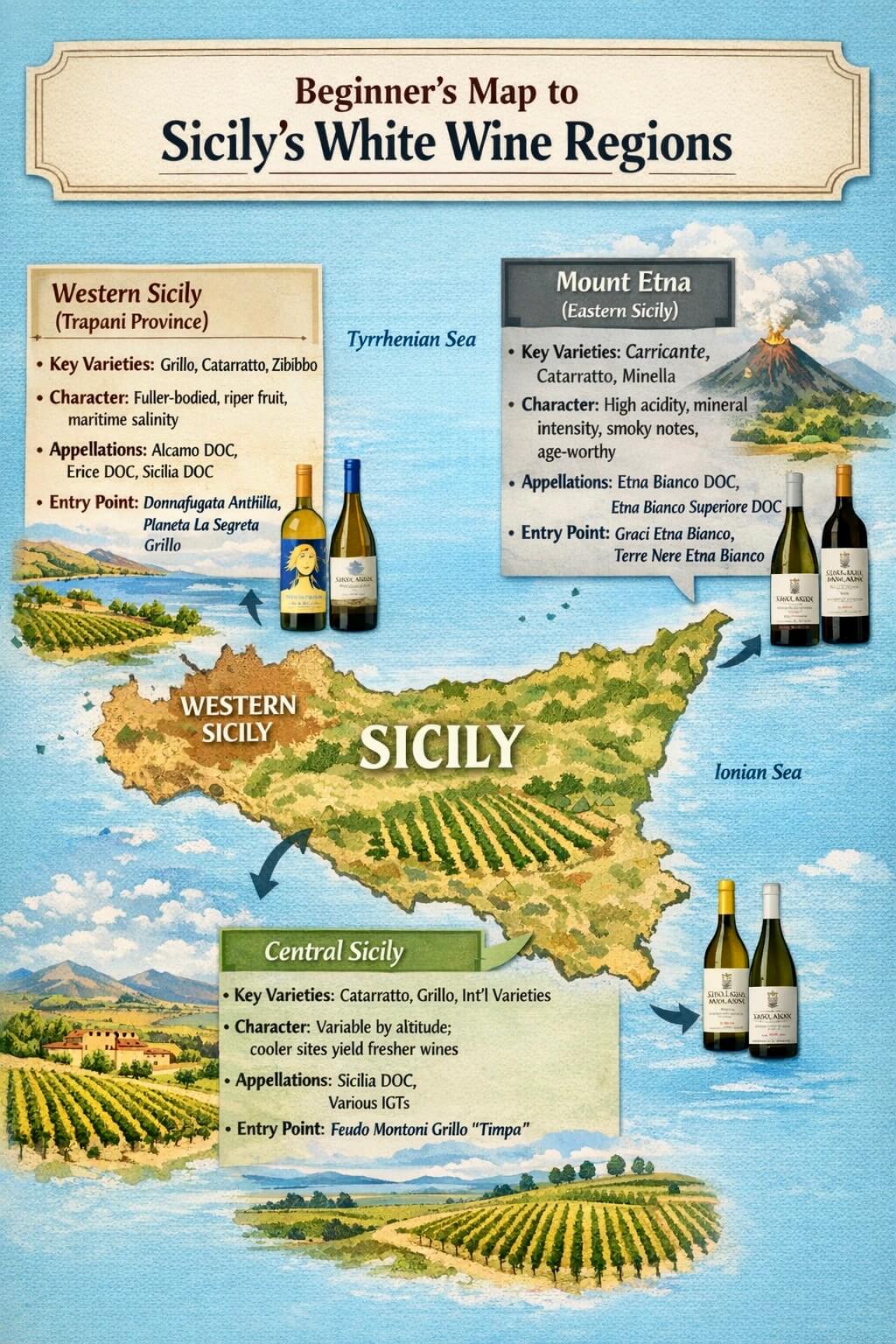 Cheat sheet to the white wine regions of Sicily.
Organic Farming
Organic and biodynamic viticulture have gained significant traction across Sicily's wine regions, where the island's climate favors these approaches due to abundant sunshine and low disease pressure.
The volcanic and limestone soils respond particularly well to organic amendments, their living microbial communities contributing to wine complexity through enhanced nutrient cycling.
These practices align with the broader movement toward terroir expression and minimal intervention, allowing the land's voice to speak more clearly through the wine.
Sicilian White Wine Brands
Sicilian white wine brands range from historic estates with centuries of family ownership to ambitious newcomers reshaping the island's vinous landscape.
Planeta is the most internationally recognized name, with extensive holdings spanning multiple DOCs and showcasing both indigenous and international varieties.
Benanti pioneered quality winemaking on Etna's slopes, with their Pietramarina Carricante setting the standard for the region.
Donnafugata combines innovation with tradition, showcasing Sicily's diversity through wines from across the island.
Smaller producers like Passopisciaro, Terre Nere, and Graci have achieved cult status among collectors for their meticulous single-vineyard Etna whites.
Cooperatives such as Settesoli and Feudo Arancio offer excellent value, thanks to their scale, enabling access to quality fruit at affordable price points.
The landscape encompasses every tier from everyday drinking to investment-grade rarities.

Price Range of White Wines of Sicily
The pricing reflects quality and scarcity, with entry-level Sicilian whites beginning around eight to twelve euros per bottle. These offer genuine value: their quality far exceeds that of wines at a similar price from many other regions. Thanks to the Sicilian sun and indigenous varieties, which deliver concentration and character at a modest cost.
Mid-range bottlings from respected producers occupy the fifteen to thirty euro bracket, representing the sweet spot of quality and accessibility.
Premium single-vineyard wines, particularly from Etna, command 40 to 100 euros or more, their limited production and critical acclaim justifying the investment.
The rarest contrada wines from top producers can exceed these figures, entering the realm of collectible wines where scarcity and reputation drive pricing.
Yet value persists across all tiers, Sicily's relative obscurity compared to Tuscany or Piedmont meaning that quality remains underpriced relative to international peers.
What to Buy Right Now
Due to the wide selection, finding many Sicilian wines outside the island can be difficult. True wine lovers should consider traveling there and visiting the wineries if possible.
Specialized wine merchants and importers focusing on Italian wines typically offer the broadest selections, their buyers having established relationships with Sicilian producers.
Online retailers have democratized access, platforms like Wine-Searcher enabling consumers to locate specific bottlings across multiple vendors.
In Sicily itself, visiting wineries provides the most direct connection to producers, many of whom offer tastings and direct sales from their cellars.
Enotecas in Palermo, Catania, and other Sicilian cities stock comprehensive local selections, their proprietors often possessing deep knowledge of regional producers.
For those beginning their journey, Donnafugata Anthìlia 2023 (approximately $16–20) offers an impeccable introduction—a blend of Catarratto and other indigenous varieties that delivers white flowers, sliced pear, and wet-stone minerality, with silky textures that belie its modest price. This is Sicily distilled into an everyday pleasure, a wine for Tuesday evenings and spontaneous gatherings.
Planeta La Segreta Grillo 2023 ($12–16) represents perhaps the finest value in Sicilian whites, its peachy richness and saline finish demonstrating why Grillo has emerged from Marsala's shadow to claim its own identity. The wine speaks of the western coast with every sip.
Ascending in ambition, Feudo Montoni Grillo 'Timpa' 2023 ($22–25) reveals what this variety achieves on steep slopes—92 points from Wine Enthusiast attest to its sparkling aromatics of lemon, herbs, and delicate floral notes. The vineyard's 70-percent grade contributes a tension that elevates this beyond mere refreshment.
Graci Etna Bianco 2023 ($28–35) introduces the volcanic dimension, its 85% Carricante and 15% Catarratto blend offering mineral tension, citrus precision, and an elegant finish that hints at Etna's profound potential. This wine rewards contemplation.
Tenuta delle Terre Nere Etna Bianco 2023 ($29–35) delivers a similar volcanic character, with smoky minerality, crushed rocks, and citrus-tinged peach—a wine that earned 95 points from critics who recognized its precision and focus.
For the serious collector, Benanti Pietramarina Etna Bianco Superiore ($125–170, depending on vintage) remains the benchmark against which all Etna whites are measured. The 2020 and 2021 vintages currently available demonstrate why this 100% Carricante from old vines in Milo has achieved legendary status—wines of piercing acidity and mineral intensity that will evolve magnificently over two decades.
Those seeking single-vineyard expressions should pursue Terre Nere "Calderara Sottana" Etna Bianco 2023 ($43–48), sourced from 600–650 meters elevation, or Graci "Muganazzi" Etna Bianco 2022 ($60), both representing the contrada concept at its finest—specific volcanic terroirs captured in glass.
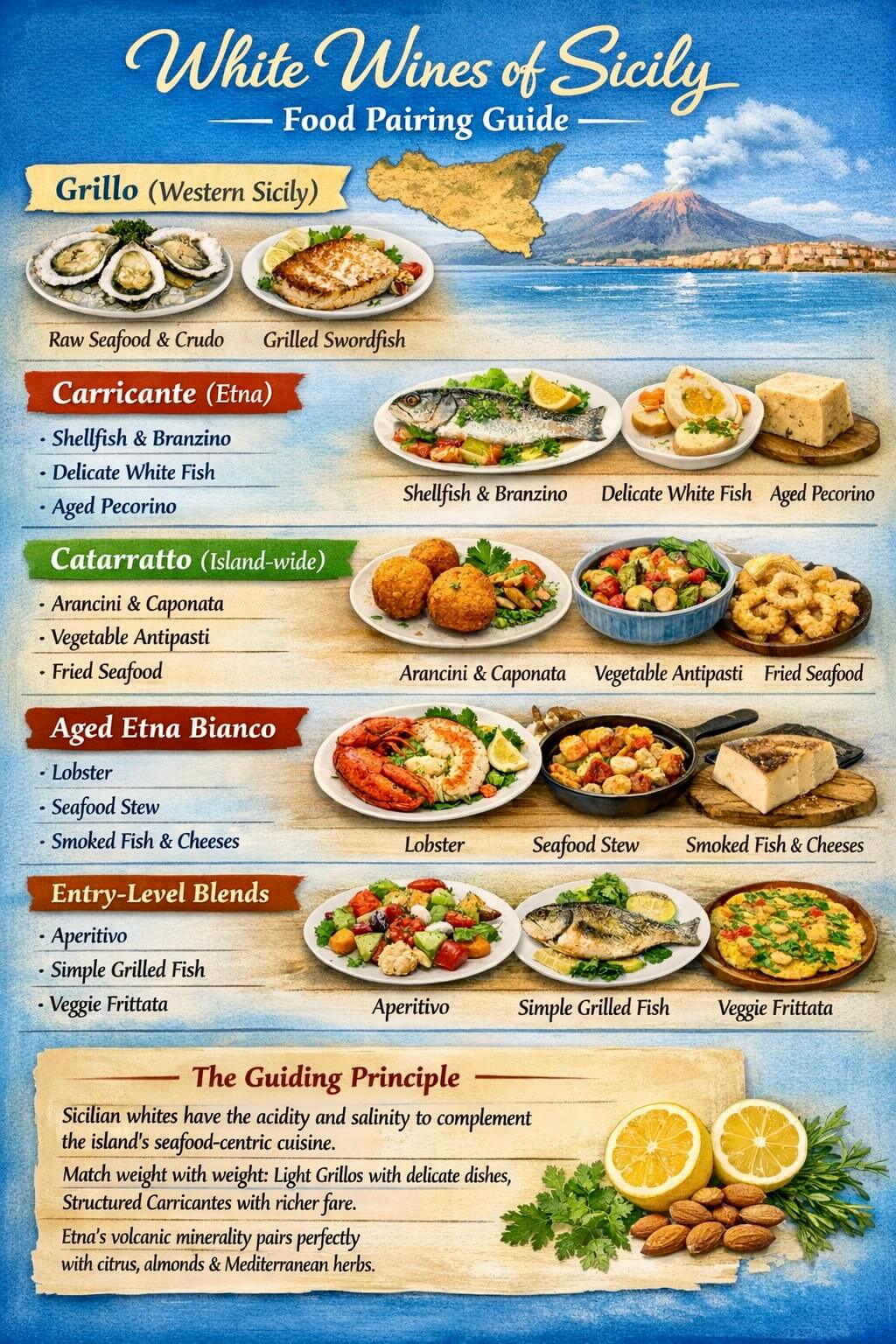 Food pairing cheat sheet for the white wines of Sicily.
The Future of Sicilian White Wines
The future of white wines of Sicily appears luminous, built on the foundations of indigenous varieties, diverse terroirs, and committed producers.
Younger generations return to family estates with formal training and a global perspective, combining traditional knowledge with contemporary technique.
Investment in cellar technology—temperature control, gentle pressing, precise fermentation management—has elevated quality across the board.
Climate change poses challenges, particularly regarding acid retention and alcohol levels, but Sicily's altitude diversity offers opportunities for adaptation.
The growing international recognition of Sicilian whites creates market opportunities that incentivize continued quality improvement. The momentum is building. It suggests Sicily will claim its place among the world's elite white wine regions within the coming decade.

Conclusion
We have outlined Sicily's white wine renaissance, from the sun-scorched western plains to the volcanic heights where Etna produces wines of almost austere beauty.
What emerges is a portrait of transformation—an island awakening to its potential.
The white wines of Sicily now occupy a singular position in the world of fine wine: they offer complexity and terroir expression that rival the great whites of Europe, yet they remain accessible in both price and spirit.
The future for Sicilian whites is luminous indeed. As international recognition grows and younger generations bring fresh energy to ancestral vineyards, the island will claim its rightful place among the world's essential white wine regions.
(January 6, 2026)
You might like these:
Marsala Wine - Rich Flavors and Timeless Elegance
Marsala wine is a specialty from island of Sicily. Learn what it is like and how you can use it.
Sicilian Food - Rich Flavors, Endless Passion
All you need to know about Sicilian food, its ingredients and history.
Sicilian Arancini - Delicious Rice Balls from Southern Italy
Sicilian arancini: Find more about this famous food, traditional to Sicily.
Difference Between Madeira and Marsala Wines
What's the difference between Madeira and Marsala wines, and which one you should choose?
How Long Does Marsala Wine Last in the Fridge?
How long does Marsala wine last in the fridge? Learn how to savor the flavor as long as possible.





Want more Sicily like this?
I post short cultural threads and decision-filters for slow travelers—so you can choose experiences without spiraling.
Follow:
Contact: vesa@manyfacesofsicily.com
Recent Articles


-
Markets in Palermo: Which Fits Your Day Best?
Jul 22, 26 03:54 PM
 Choose the right markets in Palermo, from Ballarò’s full sensory rush to Il Capo’s easier flow, plus what to eat and when to go.
 -
Things to do in Catania for a Slower Stay
Apr 12, 26 02:00 PM
 Use this honest guide to things to do in Catania if you want Sicily to feel lived-in, beautiful, and easier to navigate without overplanning.
 -
Things to Do in Palermo (Go Slow, Choose Well)
Mar 24, 26 01:14 PM
 Things to do in Palermo, curated for slow days: choose markets vs. museums, sea walks vs. catacombs, plus Monreale, Mondello, and Cefalù by train.