Leonardo Sciascia
- Home
- Main Cities in Sicily
- Palermo
- Palermo Markets
Markets in Palermo: How to Choose the Right One
 Markets in Palermo are great when looking for fresh ingredients.
At one market, fish scales still glitter on the table at breakfast; at another, the real crowd arrives after dark. Markets in Palermo are not all trying to give you the same experience, which is why generic advice often feels useless.
If you want the city to feel lived-in rather than staged, the better question is not which market is "best," but which one fits your pace. This guide offers simple tradeoffs: Ballarò or Capo for a first morning, La Vucciria for evening energy, Borgo Vecchio for a more local rhythm.
Along the way, you'll get just enough history to understand why these places matter without losing the practical thread. By the end, you'll know where to start and why.

The Life at the Markets in Palermo
The markets in Palermo carry a particular density of meaning because the city has long been a crossroads for different civilizations. You'll find finer artifacts in the museum, but the markets are where history is still alive.
With the right kind of eyes, you can see all the layers that this island has gone through before arriving here, in this moment.
If you are staying in Palermo for any length of time, the markets are the fastest way to immerse yourself in the texture of daily life.
There are no outsiders in the market; everybody is a part of the play, whether they like it or not.
A Short History of the Markets in Palermo
The origins of Palermo's great open-air markets can be traced directly to the Arab period of the ninth and tenth centuries.
The Arabs brought with them a market culture rooted in the souk—a tradition of dense, specialized, sensory commerce conducted in narrow lanes, organized by product type, and animated by the art of vocal persuasion.
After the Arabs came the Normans, who did not so much dismantle Arab commerce as synthesize it with European trading practices.
The result was distinctly Sicilian market culture: hierarchical in its organization of goods, theatrical in its vendor performances, and deeply communal in its social function.
This culture has survived to this day in Palermo's markets.
What Products Will You Find in the Sicilian Markets
Before going further into specific markets, it helps to know what the Sicilian market typically offers, because the range is wider than most visitors expect.
Food dominates, but it means more than produce and fish.
At a well-stocked Sicilian market, you will find fresh vegetables and fruit organized by season. Alongside produce, you will find fish and seafood that reflect Sicily's position as an island surrounded by three seas.
Swordfish and tuna are the prestige catches, both with deep cultural significance—the mattanza, the traditional bluefin tuna hunt, was a ritual as much as a harvest, though it has largely ceased.
More commonly available are sardines, anchovies, sea bream, octopus, squid, cuttlefish, sea urchins, and mussels. The quality is generally exceptional, particularly in the morning hours when the catch is freshest.
Meat stalls offer lamb, pork, and the offal cuts—spleen, lung, intestine—that form the basis of Palermo's most famous street foods.
Cheese vendors carry fresh ricotta, aged *pecorino*, and *caciocavallo*, a stretched-curd cheese that hangs in pairs from wooden beams like small golden bells.
Beyond food, Sicilian markets also carry spices, dried herbs, and condiments that make excellent, lightweight gifts or personal provisions: dried oregano, saffron from Enna, wild capers from Pantelleria, sun-dried tomatoes, and various grades of olive oil.
 Fish is a staple of every Sicilian market.
Clothing stalls, household goods, and secondhand items are common in larger markets, particularly at the edges where the food section thins out.
Some markets include sections for antiques and flea markets.
The key distinction to hold in mind is between the mercato alimentare (food market) and the mercato delle pulci (flea market)—they often coexist in the same space but operate on different logic.
Palermo: The City Where Markets Are a Way of Life
Palermo is the undisputed capital of Sicilian market culture, and its street markets are among the most historically significant in the Mediterranean.
The city contains four major historic markets—Ballarò, Il Capo, La Vucciria, and Borgo Vecchio—each with its own neighborhood, personality, and social function.
The four markets are close enough to each other that a determined walker could visit all of them in a single day. The slower approach allows for the small, unplanned encounters that tend to be the most memorable.
Sit down, order a spritz or a granita - coffee, whatever - and enjoy the show.
Mercato di Ballarò: The Oldest and Most Alive
Ballarò is Palermo's oldest and largest market, and it remains the most genuinely embedded in the daily life of its neighborhood.
It stretches across several blocks in one of the city's oldest and most densely populated districts.
Ballarò is packed with fresh seasonal produce, meats, and seafood, as well as vendors selling clothing, spices, and household goods - as described in Eating Europe's March 2026 guide to the market.
The Albergheria quarter that surrounds Ballarò has been shaped by centuries of immigration. First Arab and Norman, then Spanish, and in more recent decades by North African and sub-Saharan African communities.
The market does not feel preserved or curated; it feels continuous, as if it has simply never stopped. It hasn't done so for a thousand years, since Arab times.
For the traveler interested in people and their ways, Ballarò offers more human variety per square meter than almost anywhere else on the island.
 You'll find plenty of everything in Ballaro.
Mercato del Capo: The More Intimate Alternative
If Ballarò is the market that overwhelms, Capo is more welcoming and easier to approach. It's also smaller in size. Still, you'll find the standard selection of goods found at Sicilian markets: fruits, vegetables, fish, food, spices, and other goodies.
The Seralcadio neighborhood is a historic quarter dating back to the Muslim era. Il Capo stretches along several streets, running from the Porta Carini city gate through a network of narrow lanes.
Surrounding neighborhood's Islamic-era origins are still legible in the street plan—narrow, winding, shaded. The market fits its surroundings: it feels less like a spectacle and more like a daily ritual.
Although tourists have also discovered Capo, the atmosphere remains authentically Sicilian. Like Ballaro, this market serves as a place where locals shop and socialize.
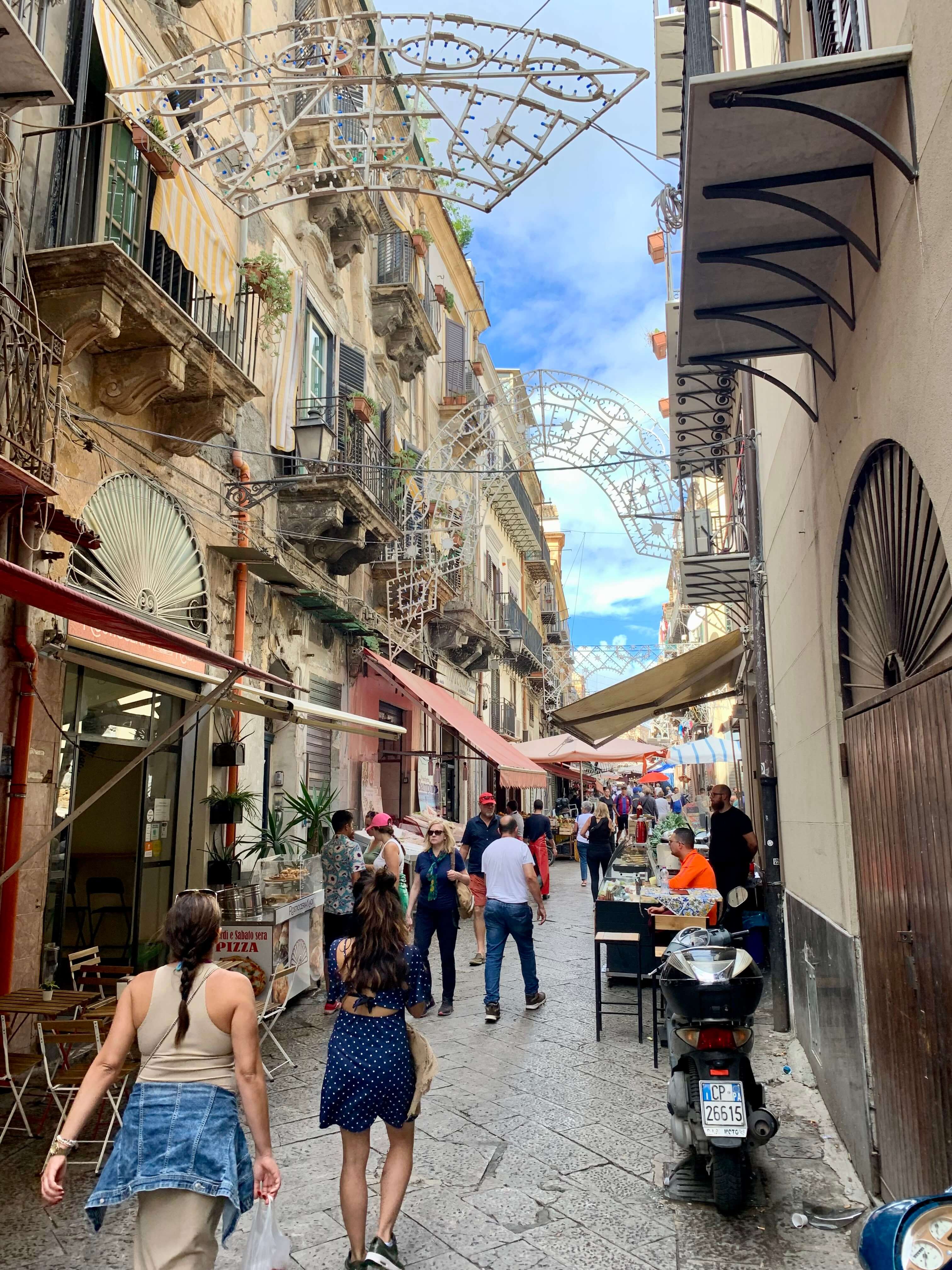 Capo Market in Palermo.
Il Capo is primarily a food market, and its food is excellent. Fish scales glisten on the vendors' tables; fruit and vegetables arrive in the kind of condition that makes you understand why Sicilian cooking needs so few ingredients—the produce is already doing most of the work.
The street food at Il Capo includes the same Palermitan classics found at Ballarò. Still, the atmosphere is slightly less intense, which some visitors find more comfortable for a first market experience.
The practical tradeoff between Ballarò and Il Capo is essentially this: Ballarò offers more variety, more intensity, and a more complex social texture, but it can feel chaotic.
Il Capo offers a slightly more navigable experience without sacrificing authenticity. If you are visiting Palermo for the first time and want to ease into market culture, Il Capo is a reasonable starting point.
La Vucciria: A Market That Became Something Else
La Vucciria is the oldest market in the city—its origins predate the Norman period.
It was immortalized in a 1974 painting by Renato Guttuso that captured its mid-century peak: a dense, chaotic, luminous scene of hanging meats, fish, and human figures that became one of the most recognizable images of Sicilian life.
The reality today is more nuanced. La Vucciria still has old-school stalls, but it has also become a hub for al fresco dining and nightlife. Particularly in the evenings, the square fills with young Palermitans drinking and eating at outdoor tables.
 Vucciria in the morning.
The daytime market function has contracted, but the evening social function has expanded, and what has emerged is something genuinely interesting: a space that operates as a food market in the morning and as one of Palermo's most spirited outdoor gathering places at night.
Times change, but some things don't. The bar Taverna Azzurra has been operating in the Vucciria since 1896.
The honest assessment of La Vucciria: it is worth seeing, particularly for its historical significance and its evening energy, but it is no longer the best place to experience Palermo's daily food market life.
Go in the morning to see what remains of the food stalls, then return at dusk to see what the space becomes when the vendors pack up, and the neighborhood reclaims it.
 Vucciria by night.
Borgo Vecchio: The Local's Market
Borgo Vecchio is the fourth of Palermo's major markets and is the least visited by tourists, which, for some, might be a recommendation in itself.
Located near the port in the Borgo Vecchio neighborhood, it operates primarily in the evenings rather than the mornings, which sets it apart from the other three.
The evening market format means that it functions as a neighborhood gathering place as much as a commercial space: families shop for dinner, children run between stalls, and the atmosphere has a domestic quality that the more famous markets sometimes lack.
Markets in Palermo: Conclusion
Four markets, one city, a thousand years of uninterrupted commerce.
For the main markets, the advice is simple: go early, go hungry, and go without a fixed agenda.
Deciding where to start, let your temperament guide you.
Il Capo for a first morning, when you want to find your footing. Ballarò, when you are ready for the full force of it. La Vucciria at dusk, when the stalls close and the square fills with people. Borgo Vecchio, when you want to go local.
What all four markets share is more important than what separates them. They are places where the city is still doing what it has always done: feeding itself, selling to itself, arguing with itself, and gathering around the table in the broadest possible sense of that phrase.
The Arab traders who first shaped this market culture understood something that has not changed in a thousand years — that commerce, at its best, is just another form of human contact.
You came to see Palermo. The markets are where Palermo will see you back.

(July 22, 2026)
Want more Sicily like this?
I post short cultural threads and decision-filters for slow travelers—so you can choose experiences without spiraling.
Follow:
Contact: vesa@manyfacesofsicily.com
Recent Articles


-
Markets in Palermo: Which Fits Your Day Best?
Jul 22, 26 03:54 PM
 Choose the right markets in Palermo, from Ballarò’s full sensory rush to Il Capo’s easier flow, plus what to eat and when to go.
 -
Things to do in Catania for a Slower Stay
Apr 12, 26 02:00 PM
 Use this honest guide to things to do in Catania if you want Sicily to feel lived-in, beautiful, and easier to navigate without overplanning.
 -
Things to Do in Palermo (Go Slow, Choose Well)
Mar 24, 26 01:14 PM
 Things to do in Palermo, curated for slow days: choose markets vs. museums, sea walks vs. catacombs, plus Monreale, Mondello, and Cefalù by train.